Categories
Uncategorized

Soft Skills – Hard Measures

Every training manager finds himself struggling (and even conflicted) with the issue: how to measure the effectiveness of training? Is it even possible to quantify soft skills? What happens “the day after” the training? How does one actively implement the Kirkpatrick Model (which, in spite of its being the most well-known model in the world for measuring organizational study, it is actively implemented in less than 20% of the organizations….)?

There is overwhelming agreement among managers that soft skills, and in our case, communications and message delivery skills, are a positive and necessary condition for succeeding in business and for effective organizational management. But how can we really know the communications capabilities of our employees and managers? Where are they on the scale concerning their communications abilities, in relation to other employees in the organization or outside of it? To what level do they succeed in conveying the correct messages in a way that creates the desired impact? And most important, how can we measure and quantify their success rate?

The answer to all these questions can be found in CQ = Communication Quotient

One of the sharpest criticisms of the emotional intelligence quotient tests, EQ, is the fact that they are too general and too broadly based. Luke (2005) claims that the definition of the concept isn’t stable and as a result it has too many varied components to be included in the framework of one theory. The CQ gauges actually supply a solution to this criticism, as they evaluate and measure only the skills affecting communication and the transfer of messages.
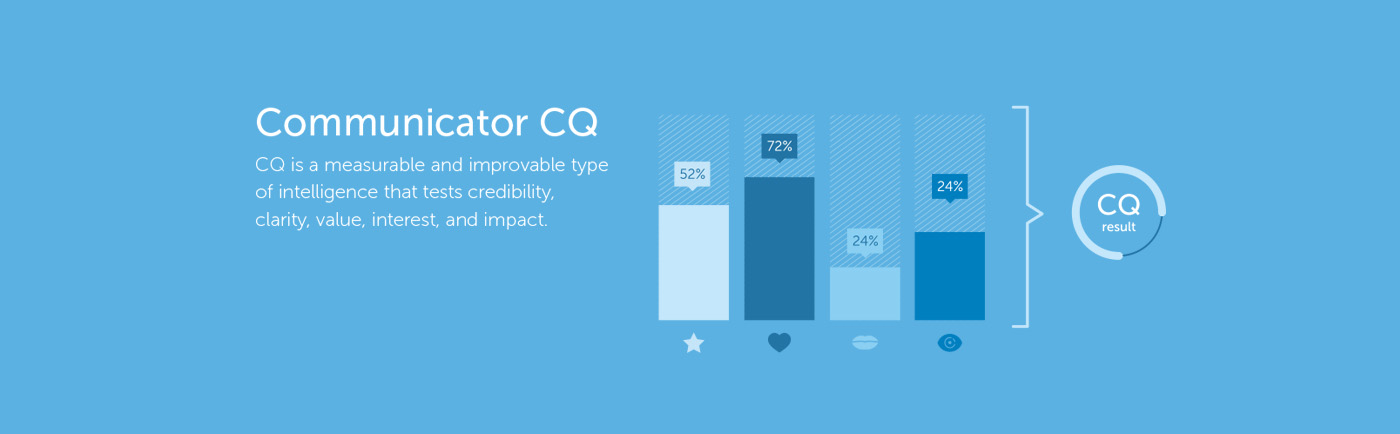
slide_cq_completeh

How can CQ help managers in your organization?

  1. Mapping and diagnosis of managers (or managerial reserve) according to measured parameters, such as:
  • How well does the manager transmit messages in a clear and precise manner?
  • How well does the manager present a valuable message to the person opposite him/her?
  • Does the manager create interest in his message and turn it into something those listening to him will remember?
  • How well does the manager succeed in creating an impact on his surroundings?
  • To which style of speech patterns does the manager belong?
  1. Specific compatibility of tools and models for maximum and surgical improvement of communications and message transmittance based on mapping and diagnosis. The following parameters will be considered when building the program:
  • KPI’s of the manager or group of managers.
  • The format that will make maximum improvement possible: guidance, computerized learning, face-to-face consultation.
  • Time period needed to achieve the necessary improvement
  1. Evaluation of improvement, follow-up on the learning graph and implementation during the entire process
  • Initial evaluation grade based on CQ predicted parameters
  • Determination of desired result for measuring improvement
  • Evaluation report of quality (verbal) and quantity (numerical) with points that are determined as landmarks in the learning process and its completion.


How was the CQ idea born?

For the past 12 years the VAYOMAR has specialized in developing methodologies and models for interpersonal communications and message delivering. The thousands of workshops and consultations that we have performed gave us the opportunity to become closely acquainted with the strengths and obstacles that characterize employees and managers when they need to convey messages. Cross-checking our wide data base with up-to-date academic studies in the field of communications, led us to the development of the unique CQ, which includes:

  • 5 core measurements on a quantifying scale for predicting an outstanding speaker
  • Listing 8 typical speaking styles

CQ will help you to know not only how employees or managers begin the learning process and what it includes; it will also help you to know how they complete the process and where they will end up when it’s completed.


Categories
Uncategorized

Enhancing Your Influence

Every person is looking for a way to maximize his input, whether it’s in a big or small way.

One of these ways is becoming an asset to the big decision-makers at a company.

How can you be sure that your suggestions are helpful and not hindering? CLICK HERE to take a look at our infographic on Enhancing Your Influence and learn more!

Categories
Uncategorized

Conscripting Innovation

By, Gur Braslavi and Stephen Fox

We often associate great intellectual breakthroughs with a single eureka moment of a single inventor, such as Newton’s apple. The reality, though, is that innovation is the moment when many smaller ideas are pulled together to deliver a unified solution to a specific problem. Those who are skilled enough to accomplish this alone come around once in a lifetime. What about the manager who needs to innovate within his own company? There must be a better solution than waiting to hire the next Albert Einstein to the R&D department. Rather, managers must learn to harness the existing powers of their organizations in order to find solutions faster and more reliably. The answer is conscripting innovation.

What exactly does it mean to conscript innovation? The word “conscript” is typically a military term, meaning to be drafted or compelled into service. So to conscript innovation means to be drawn to be innovative, drafted into being creative.

The challenge is not for us to provide the solutions to our own problems, but rather to conscript a wide spectrum of talents together in order to innovate. Introducing new lines of thought and skills into the solution process allows us to break free from the internalized boundaries we have set for ourselves and find solutions that may otherwise have been overlooked. The problem is how to entice others to join you on your quest for the next great idea that will change your business, or maybe even your entire industry.

Conscripting innovation is a three-part process that will allow you to create an ideal environment to accomplish your goals, including focusing on a specific problem, fostering an environment for success, and making a problem fun to work on.

Part 1: The first step towards conscripting innovation requires managers to have their employees focus on a single objective and direct certain people to solve a single problem. Managers must take complicated ideas and strip them down into a simpler goal that others will be easily understood. With new perspective come new solutions. Take a look at the aircraft company, Boeing, during the early 1990s; individual departments within the company lacked coordination with each other, which lead to a lot of wasted time, resources, and money. Rather than implement changes from the top down, management decided to tackle this problem by opening the lines of communication between the departments and developing “accelerated improvement retreats” for the top employees in each group. When working together, they found that many of their processes overlapped, allowing the company to cut down significantly on the overall manufacturing costs.[1] The solutions did not come from around the boardroom table, but rather used the perspective of engineers, assembly workers, warehouse managers and pilots to find innovative solutions to the company’s process of manufacturing planes.

Part 2: The second step in conscripting innovation is to foster a creative, yet productive work environment. In general, this must be done through a long process of creating a supportive company culture. While creating “thinking spaces” with bean bag chairs and foosball tables can help, the way innovative ideas are treated by upper level management is what will decide whether or not employees are willing to put their necks out on the line. The way to achieve it is to develop a culture of innovation that does not punish employees for taking calculated risks, even if they fail. HP Software has implemented an impressive program called the “innovation stream” in order to overcome this problem. The stream flows throughout the organization, asking for input from all departments and levels, similar to the way Boeing had done; however, the difference is in the encouragement that HP gives their employees. They can receive points for submitting ideas, critiquing the ideas of others, and lending their expertise to design teams for the best ideas. These points can be used to purchase days off and other benefits. More importantly though, employees who are serious about working on their innovations are given time each week to work in development teams. HP has found that when employees are allowed to take the lead on their own ideas, it allows the large company to develop the entrepreneurial spirit that used to be reserved for smaller, start-up companies. This culture of innovation gives employees the courage to put forth their ideas and the support to turn them into products that will help HP continue to grow.[2]

Part 3: The third step of conscripting innovation says that the assignments employees are working on must be fun and enjoyable. Studies have found that people are far more willing to expend their time, energy and resources on tasks that they enjoy. An example of this can be seen in the discovery of supernova, where each year more professional and amateur astronomers search larger portions of the sky for these rare phenomena. The result has been an exponential increase in the discovery rate of supernova and many more associated breakthroughs in the astronomy community.[3]

In finding an innovative solution to your own problem, the dilemma becomes how to conscript others to work together. This requires focus on the question at hand, a culture that promotes innovation, and most of all, a fun and enticing process that attracts others to actually want to invest their time. You are not trying to bring the solution to others, nor are you assuming to know what the solution may be, nor are you saying there is even a viable solution. What you can do is bring together the collective knowledge necessary to find an innovative solution. So what is the focus of your company: on finding the solution to your problems or learning how to conscript others to innovate with you?


[1] “Can Boeing Fly High Again?” Http://www.maths.tcd.ie/~nora/FT351-3/CS.pdf. N.p., n.d. Web. 10 Nov. 2012.
[2] Gvirtsman, Ahi. “HP Innovation Stream.” Tel Aviv, Israel. 13 Nov. 2012. Lecture.
[3] http://www.universetoday.com/26495/a-supernova-story/

Categories
Uncategorized

The Dangers of Multitasking

A survey conducted by AllJobs in 2013 yielded that multitasking, along with credibility and teamwork, is one of the top three traits employers want in an employee. Multitasking. Have you ever actually stopped and wondered what it would be like to truly multitask? What we mean here is focusing your brain equally on more than one task at a time. It’s impossible to have your brain focus completely on more than one task. Since multitasking is one of the most sought-after traits employers look for, more and more job seekers are listing it as a skill on their resumes. But should employers really be looking for multitasker as their ideal employee?

Multitasking is the ability to perform a number of tasks simultaneously without it compromising the quality and efficiency of the performance.  A simple experiment held in a number of universities across the country sampled a large number of students who were asked to write a row of 10 numbers (1-10) on a board, and below it a row of letters (A-J).  The second time around, they were asked to perform that same task but this time, write a number-letter, number-letter alternately. The observation showed a clear decrease in the efficiency when the participants performed the second task.

According to David Meyer, a cognitive scientist from the University of Michigan, multitasking causes our brains to slow down and increases the chances of making a mistake. Distractions and interruptions interfere with our ability to process data.

It’s true that every job seeker may declare in a job interview that one of his main strengths is multitasking, and many employers are convinced it’s an attractive trait that one cannot succeed without. However, in recent years, cognitive scientists, psychologists, and management professors have challenged the necessity and prestige of such trait.  In a recent study, it took a group of  Microsoft employees an average of 15 minutes to return to serious work after answering e-mails or text messages.  This distraction caused them to continue to engage in things that were irrelevant to their work.

A classic example of how multitasking affects our daily lives would be when you drive and carry on an important phone conversation (with a Bluetooth, of course) at the same time.  Suddenly, you find you’ve taken the wrong turn, even if it’s the same way you’ve driven home for the last 10 years.  Multitasking not only affects efficiency, but it also quality.  With driving, for instance, the fact that we’re busy with two parallel tasks causes us to become distracted and as a result, not only do we slow down our pace but we also tend to get lost, get off track and head straight into the car in front of us… If we multitask at work, while the danger is nowhere near as large, the outcome is similar: lack of focus and poor quality work.

Jonathan Saphira, a senior analyst in a leading research company in the U.S., estimates the cost of distractions to the U.S. economy to be approximately $650 million a year.  However, it’s important to remember that distractions at the workplace will never disappear, as that’s the nature of how work is done and how ideas pass on.  After all, what may be a distraction to one person could be collaboration to another.

Here are some recommendations for how to keep from multitasking, but still be an effective worker:

  • Prioritize tasks on a monthly/weekly/daily basis.
  • Allocate a realistic time frame for every task and don’t slip into other tasks until you have completed the first one.
  • While working on a professional task that demands great focus, it’s best to filter out any background noises and create an effective work environment (sit in a room with few stimulations, sign out of your inbox, put your phone on silent, etc.)
  • Make a list of your usual distractions (e-mails, phones, hallway conversations, etc.)
  • Set aside 3 timed, limited instances during the day where you engage in your usual distractions.
  • Play some peaceful music with no lyrics. Some say it really helps with concentration.

In the future, maybe employees will be able to program sensors and smart apps with their priorities so that they can serve as a sort of “Time Babysitter” that will efficiently oversee their time allocation.  But until then, it’s all in our hands!  So, try your best to keep your distractions and multitasking to a minimum, and you can become a more efficient worker and overall, a more focused person.

Still don’t believe that multitasking is that difficult? Try playing this game and see your results.

Categories
Uncategorized

Are employees snoozing through your meetings? Here's the solution

In most organizations, team meetings are perceived as useless and boring.  No matter how hard you may try to make it interesting, your employees still seem restless.  How can we make these meetings effective AND engaging?  Before we try to understand how to do that, let’s ask ourselves the following question: what are the classic problems managers run into during staff meetings?

  • Employees show lack of interest and are busy chatting.
  • Employees arrive late.
  • Employees walk out to take phone calls.
  • There is no internalization and implementation of the points raised in the meeting.

However, this is not a one-way street.  If we were to ask your employees the exact same question, they would probably say that:

  • Meetings start late.
  • Meetings don’t end on time.
  • They are boring.
  • They are ineffective.
  • The message isn’t clear.
  • There’s information overload.
  • The topic doesn’t pertain to everyone present but only to some departments.

The following model attempts to tackle some of these problems:

A Model for Constructing Staff Meetings to Motivate Employees

  1. Present the meeting objectives in a precise and concise manner.  A clear objective and vision instill commitment among employees.
  2. Present the rationale behind the objectives (for example: other ruled-out alternatives, examples of past experiences, your position in relation to competitors, case studies that led to developing such a procedure, simulations, roll switching, etc.) – the “what” isn’t enough; it’s also important to understand the “why.”  The more an employee takes part in making decisions, the more committed he is to perform his tasks in the best way possible.
  3. The implications (value, benefit) of meeting objectives on any level (individual/group/school) – what do we gain by achieving our goals? It is important for employees to see the end result of their hard work and effort.
  4. Predicting and presenting possible resistance – when a manager knows how to detect and bring to the surface possible backlash before his employees do, he’s able to minimize the degree of resistance and show that he knows the situation up close.
  5. Holding a discussion about the working methods to achieve the goals – a good manager should encourage creative thinking and teamwork.

When a manager builds his staff meetings based on this model, the message he is sending is a positive one.  It shows he’s truly invested in his employees, that meeting them is important to him, that he doesn’t want to waste their time, that he understands their motives, and that he knows how to appreciate their hard work.  Above all, a manager should serve as a role model and set a personal example for his employees (a factor that has been found to be key in motivating employees in the long run).