[fusion_text] [/fusion_text][fusion_text]
Summery of Instruction
[/fusion_text][fusion_text]
Message Structure
How can I focus the structure of the message in a clear and concise way that engages my audience and?
1. Grabbing Audience Attention – The opening has a decisive influence on the audience’s attention during the presentation or during the entire meeting. The opening has two elements that are cardinal to success:
* Coordinate expectations –what are we going to talk about
* Value- what’s in it for me (benefit)
2. Body of the Message – The big challenge in the body of the message is the distinction between the essential and the inessential and to present the supporting information in a coherent flow that is memorable over time. It is recommended to divide the information into three points, arguments or main categories each with its own short and clear title.
3. Summary – Short repetition of the main points A call for operative action (as measurable as possible).[/fusion_text][fusion_text]
Audience Attention Graph
What can we do to establish audience attention?
Change tone of voice and intonation, maintain eye contact, movement across space, using your
hands (body language). In addition you can tell an anecdote, a joke, a riddle, a personal quote, a
video, an activity, a question – all of these are called audience attention boosters – anything that
breaks the routine and creates a stimulus so that the audience will keep on listening. The attention
boosters don’t replace the content, but add to it!
[/fusion_text][fusion_text] [/fusion_text][fusion_text]
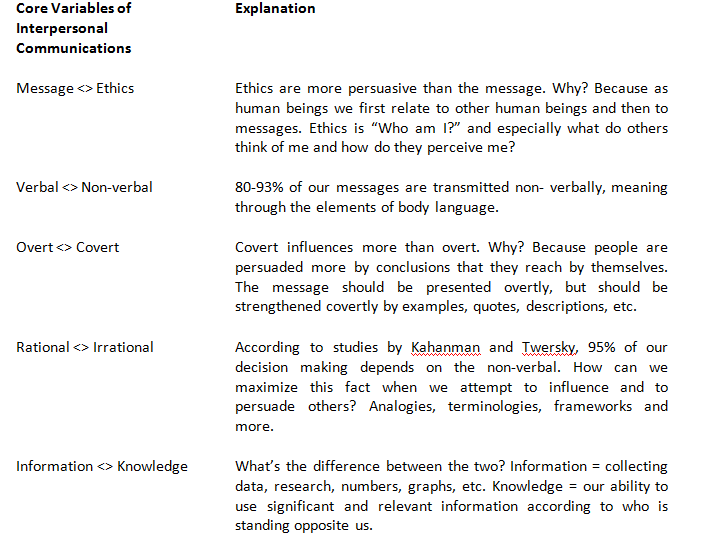
Persuasion Table – Core Variables in Interpersonal
Communications
What are the core variables in interpersonal communications?
Awareness of the following 5 sets and better use of each one of the elements will help us to
better understand what makes the person opposite us function. It will help us accommodate
ourselves and our message to our target audience.
[/fusion_text][fusion_text] [/fusion_text][fusion_text]
Presentationas a Decision-Making Tool (the 5 elements)
1. Mirroring Objectives – presenting the values that the presentation will create to my target
audience. This is the desired result (as defined by the decision-makers).
2. Recommendation– a call for action that involves allocation of resources. It also involves risk
concerning the way in which your suggestions are linked to the presented goals/objectives.
3. Laying the assumptions – These are future based assumptions based on supporting information.
4. Supporting Information – factual content, research studies, data, statistics, facts that show how you reached your basic assumptions.
5. Measurements of success – a series of methods by which the groundwork can continue to be checked after beginning to follow the recommendations, but a good while before all the necessary
resources needed to fulfill the recommendations are put into use.
[/fusion_text][fusion_text]
60 Second Pitch
One of the big challenges facing every entrepreneur is how to explain an innovative and complex
idea when he has only one minute at his disposal. The good news is that there is no correlation between the complexity of the idea and the amount of time needed to present it. If we haven’t succeeded in presenting the project clearly and simply in one minute, we can assume that even eight minutes won’t be enough.
4 Components for Presenting a Project in One Minute
Impressive opening – for example, a surprising statistical fact about the market share, extent of
income, size of the problem.
* Basic identity – What is the product in terms of: the market field, value (benefit), innovation.
* Achievements – what have we already done to advance the idea.
* Call to action – what is the next step that the audience is requested to take part in.
[/fusion_text][fusion_text]
Value Oriented Thinking and Communication
High level approach
Combine foundational insights around effective interpersonal communication with practical tools relating to “Real Time” persuasion, “Value Orientation” and ongoing “Relationship Management”:
1.Value Oriented Thinking and Communication – (a) How to adopt a value oriented approach; (b) How to scope the client’s true needs and conduct “Value Discovery” processes through “Consultative Dialog”; (c) How to frame every interaction and offering in context of the client’s desired end state (business and operational).
2.Are you an asset or a burden? The Science of Relationship Management –
- a) Identifying relevant decision makers (key stakeholders on the client side).
- b) Performing quantitative and qualitative analysis of interactions with these
- c) Building a platform for quantitative and qualitative monitoring of these interactions.
Measures of Success
1.Impact on length of sales cycles.
2.Retention and up/cross-selling within existing accounts (“Farming”)
3.Reduced number of escalations (internal emphasis).
In the following pages of this document, please find a brief overview of the methodologies that will be taught during this process. Please feel free to let me know if you have any questions or require any additional materials or clarifications.
Value Oriented Thinking and Communication
This is a mode that frames every question, communication or action in context of the desired end states (your own as well as other’s) which represent a minimally acceptable ROI on the risk taken to get there. Highly effective in the service of establishing relevance in the eyes of those whom you wish to influence, this method is the foundation of establishing yourself as an ASSET to your key stakeholders and a critical component of “Executive Presence“.
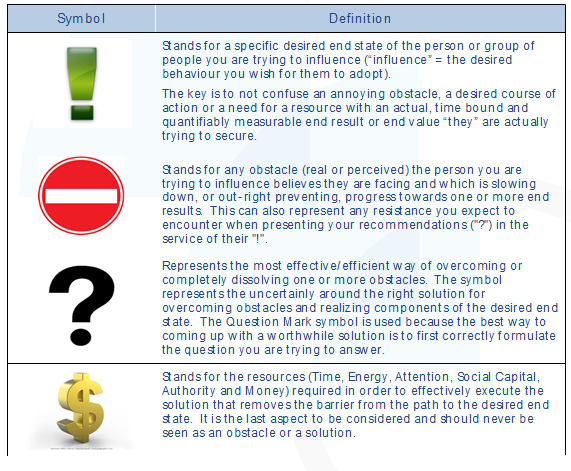
Value Dashboard
The “Value Dashboard” is a tool that allows for a single slide view of an entire “Account Centric Strategy”. Up until our company’s offerings are listed in this table, the key is to populate the columns in as impartial a way as possible – thinking like a true “Trusted Advisor”, rather than a keen “Vendor”. Not only dies this build trust, but it enables sales by truly aligning our offers with the clients most desired business and operational values.
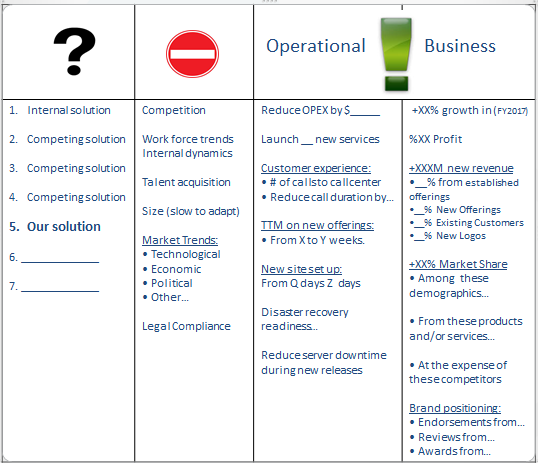
Value Matrix
The “Value Matrix” is an tool for conducting a truly thorough “Value discovery process. It allows us to go beyond the identification of high level strategic outcomes our clients are aiming for at the enterprise level. It allows us to map internal, operational and even personal aspirations that have a material (if sometime covert) impact on our key stakeholder’s decisions and operational preferences. As you descend from top to bottom of the matric, gathering the information becomes more heavily dependent on the level of trust we inspire among our key stakeholders.
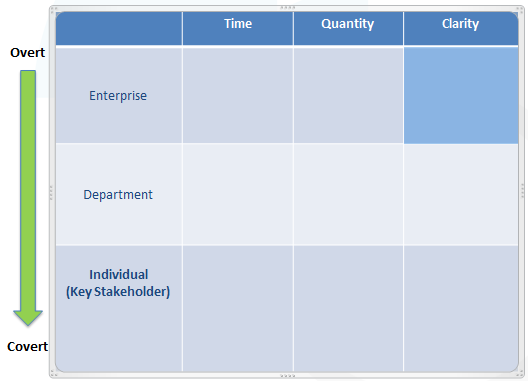
Are you an Asset or a Burden
The Science of Relationship Management
The answer to the questions “Are you an Asset or a Burden?” has perhaps the single most important ramifications on your ability to get people within your company and among your customer base to willingly collaborate with you – and therefore has a critical impact on your ability to be successful.
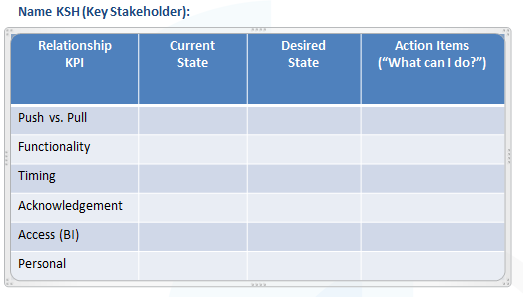
The Relationship Management model approaches internal as well as external interfacing. For sales/marketing people it can help improve the way they interact with customers and advance overall quality of relationships (driving sales and extending the “life time value” of a client).
When applied within the enterprise, this model can help improve interface management, promoting better flow and cross organizational collaboration (increasing efficiency and productivity). When applied in the context of customer facing, this model promises to improve overall customer experience and result in longer lasting and higher quality customer retention.
The model is intended for junior and senior managers alike, as well as for customer-facing interactions, crossing internal, inter-unit, interactions and is based on the following foundations:
- 1. Give value before you get value.
- Great relationships are always Win-Win.
- Relationships can be quantifiably measured.
- Relationships need to be proactively managed.
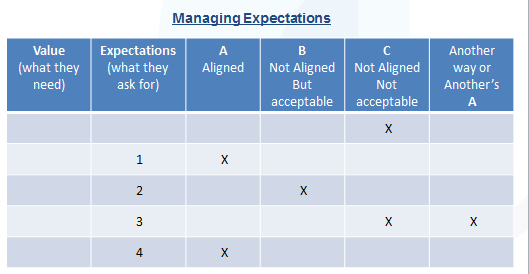
Using 6 Relationship KPIs, this training will provide practical tools that can be applied on a day by day basis and with relatively little effort to help you advance your status with a key stakeholder from “Provider” to “Trusted Advisor” to “Business Partner”.
Relationship Dashboard
 [/fusion_text]