[fusion_text] [/fusion_text][fusion_text]
Summary
[/fusion_text][fusion_text]
The Persuasion Table
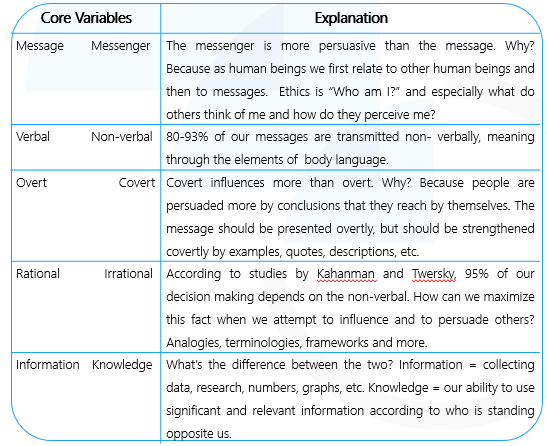
Core Variables in Interpersonal Communications
?What are the core variables in interpersonal communications
Awareness of the following 5 sets and better use of each one of the elements will help us to better understand what makes the person opposite us function. It will help us accommodate ourselves and our message to our target audience.
 [/fusion_text][fusion_text]
Presentation as a Decision-Making Tool
The 5 elements
Mirroring Objectives – presenting the values that the presentation will create to my target audience. This is the desired result (as defined by the decision-makers).
Recommendation – a call for action that involves allocation of resources. It also involves risk concerning the way in which your suggestions are linked to the presented goals/objectives.
Laying the assumptions – These are future based assumptions based on supporting information
Supporting Information – factual content, research studies, data, statistics, facts that show how you reached your basic assumptions.
Measurements of success – a series of methods by which the groundwork can continue to be checked after beginning to follow the recommendations, but a good while before all the necessary resources needed to fulfill the recommendations are put into use.
[/fusion_text][fusion_text]
Avoiding Common Mistakes in PPT Presentations
A presentation is not a substitute for a speaker – your presence is essential for understanding the message and attracting the audience. The presentation is only a tool for yourself and for your audience.
Do not read word-for-word what appears on the screen
Phrase the titles with value. Instead of titles that show content, verse your titles to present value for the listeners.
Use as few words as possible – list main points that you will expand on orally.
Coordinate expectations before a slide that is complicated or loaded with data.
Attention boosters– integrate into your presentation film clips, anecdotes, descriptions of incidents or any other element that will help you keep the audience’s attention.
[/fusion_text][separator style_type=”double” top_margin=”” bottom_margin=”” sep_color=”” icon=”” width=”” class=”” id=””][fusion_text]

[/fusion_text][separator style_type=”double” top_margin=”” bottom_margin=”” sep_color=”” icon=”” width=”” class=”” id=””][fusion_text]
Audience Attention Graph
?What can we do to establish audience attention
Change tone of voice and intonation, maintain eye contact, movement across space, using your hands (body language). In addition you can tell an anecdote, a joke, a riddle, a personal quote, a video, an activity, a question – all of these are called audience attention boosters – anything that breaks the routine and creates a stimulus so that the audience will keep on listening. The attention boosters don’t replace the content, but add to it!
[/fusion_text][fusion_text]
Value Oriented Thinking and Communication
This is a mode that frames every question, communication or action in context of the desired end states (your own as well as other’s) which represent a minimally acceptable ROI on the risk taken to get there. Highly effective in the service of establishing relevance in the eyes of those whom you wish to influence, this method is the foundation of establishing yourself as an ASSET to your key stakeholders and a critical component of “Executive Presence“.
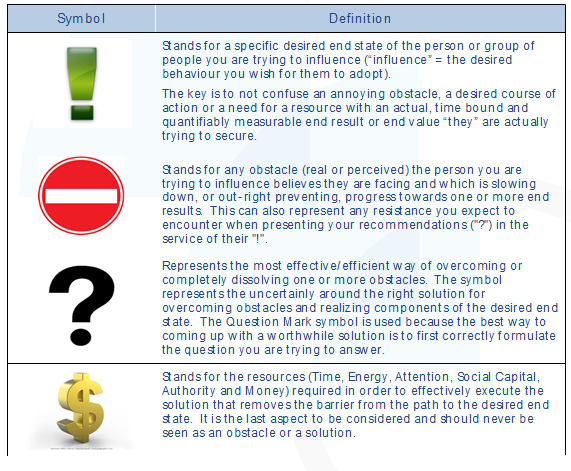
The key to applying this methodology is in the logical sequence: starting from the top and progressing downwards (whilst most people start with a “Resource Oriented” or “Problem Oriented” mindset and commonly get stuck there.
[/fusion_text][fusion_text]
Sixty Second Pitch
One of the big challenges facing every entrepreneur is how to explain an innovative and complex idea when he has only one minute at his disposal.
The good news is that there is no correlation between the complexity of the idea and the amount of time needed to present it. If we haven’t succeeded in presenting the project clearly and simply in one minute, we can assume that even eight minutes won’t be enough.
Four Components for Presenting a Project in One Minute
A Powerful Opening – for example, a surprising statistical fact about the market share, extent of income, size of the problem.
The Essence – What is the product in terms of: the market field, value (benefit), innovation.
Traction – the achievements – what have we already done to advance the idea.
A Call to Action – what is the next step that the audience is requested to take part in.
[/fusion_text][button link=”https://grace.vayomar.com/grace-period/” color=”blue” size=”” type=”” shape=”” target=”_self” title=”” gradient_colors=”|” gradient_hover_colors=”|” accent_color=”” accent_hover_color=”” bevel_color=”” border_width=”1px” shadow=”” icon=”” icon_position=”left” icon_divider=”yes” modal=”” animation_type=”0″ animation_direction=”down” animation_speed=”0.1″ alignment=”center” class=”” id=””]Grace Period[/button]